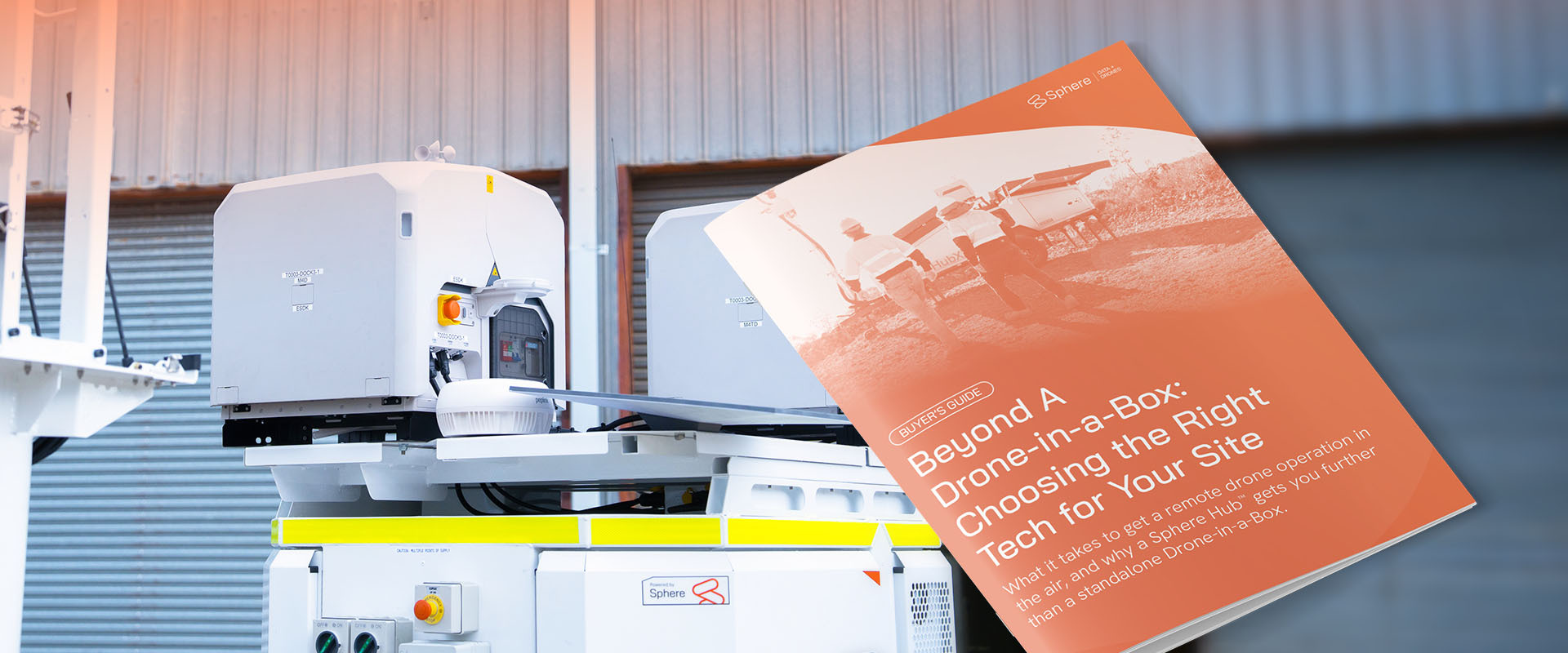
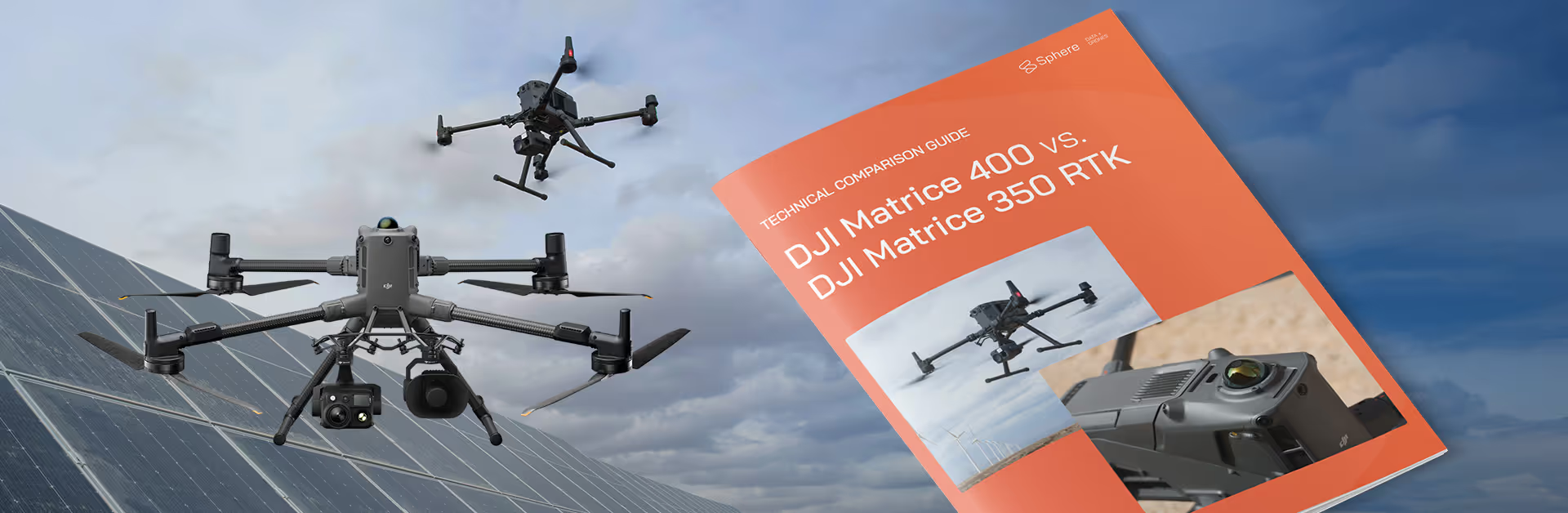
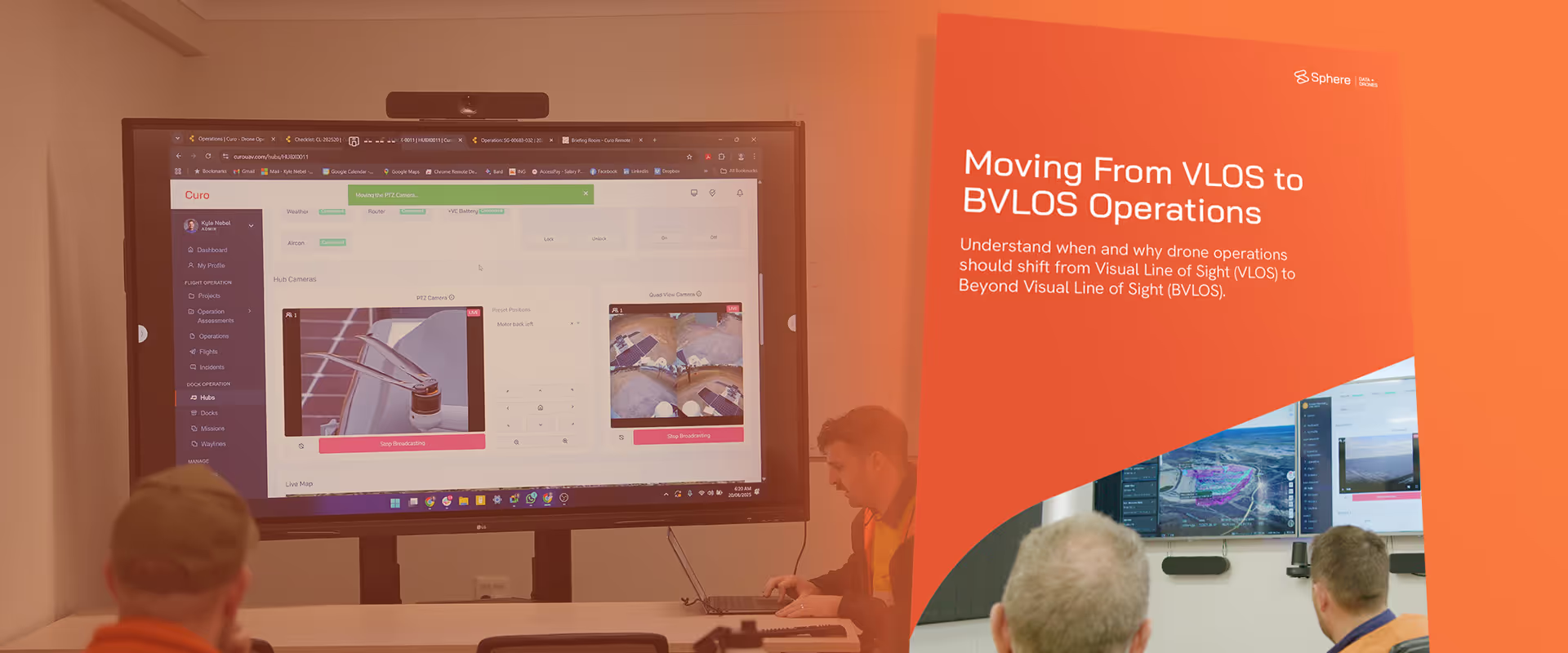
Buying a drone-in-a-box is the simplest decision in a remote operation. Getting useful data off the site, on schedule and with no crew standing next to it, is where the real work starts.
This guide sets out what a standalone dock leaves you to build yourself and how a Sphere Hub covers it, then shows which Hub best suits your site.
What you'll learn
- What a standalone drone-in-a-box actually gives you, and everything it leaves you to build yourself.
- How a full Sphere Hub compares point by point: hardware, software, pilots, compliance, support, time to live and scaling.
- The two Sphere Hubs, HubX and HubT, and which one suits your site.
- A side-by-side HubX vs HubT spec comparison across power, connectivity, terrain, install, weight and compliance.
- How the Curo suite and Sphere's Remote Operations Centre get you to a live BVLOS operation in about two weeks.
- Two real deployments: a multi-pit survey with HubX, and a rapid BVLOS scale-up with HubT.
A standalone dock vs a Sphere Hub
A dock or drone-in-a-box you buy yourself and a Sphere Hub can fly the same aircraft. The difference is everything around it, and who owns it.
On its own, a drone-in-a-box is a charging station with a drone inside. Turning that into a compliant, repeatable BVLOS operation is the part that takes the time.
Here's a sneek peak of the paths split:
- Hardware and site engineering
- Standalone: source your own cabinet, power, connectivity and site prep so a bare dock survives real conditions.
- Sphere Hub: a complete site-engineered system with redundant power and connectivity, built and tested.
- Software
- Standalone: flight operations, compliance, planning and data sit in separate tools.
- Sphere Hub: one Curo platform for compliance, operations, and data and analytics.
- Pilots and operations
- Standalone: recruit, train and roster your own BVLOS-certified pilots, limited to the hours you can staff.
- Sphere Hub: fly it yourself or hand flights to Sphere's 24/7 Remote Operations Centre.
- Compliance
- Standalone: apply for and hold your own CASA ReOC and BVLOS approval, typically six to twelve months.
- Sphere Hub: operate under Sphere's existing ReOC, BVLOS approval and BARS certification, live in about two weeks via the Broad Area BVLOS pathway.
- Ongoing support.
- Standalone: servicing, spares, firmware and troubleshooting are yours to solve on a remote site.
- Sphere Hub: managed support, servicing and rapid replacement.
- Time to live
- Standalone: procurement, build and approvals run in sequence and each can slip.
- Sphere Hub: operational within 30 minutes of connection, once approved.
- Scaling
- Standalone: repeat all of the above at every site.
- Sphere Hub: standardised units that run as one multi-site mesh, from one location to fifty.
Why teams choose a Sphere Hub
Whichever platform you choose, five things stay constant. Sphere is Australia's only vertically integrated unmanned aviation platform: hardware, software, remote operations and field delivery built and run in-house.
The technology is sovereign and proprietary: Australian-designed HubX and HubT hardware plus the Curo software suite (CuroRPA for governance and compliance, CuroROC for live remote operations, and CuroInsights for data and analytics), working as one stack with control over quality, deployment and data residency.
Operations are managed by a CASA and BARS-certified Remote Operations Centre, backed by Sphere's ReOC, BVLOS approval, and Australia's largest Broad Area BVLOS operator status. And it is proven at scale, with 35+ Hubs and 4,000+ BVLOS-supported flights in the field today.
Get the full guide
Fill out the form to download the full guide and get the complete comparison, including the HubX vs HubT breakdown.